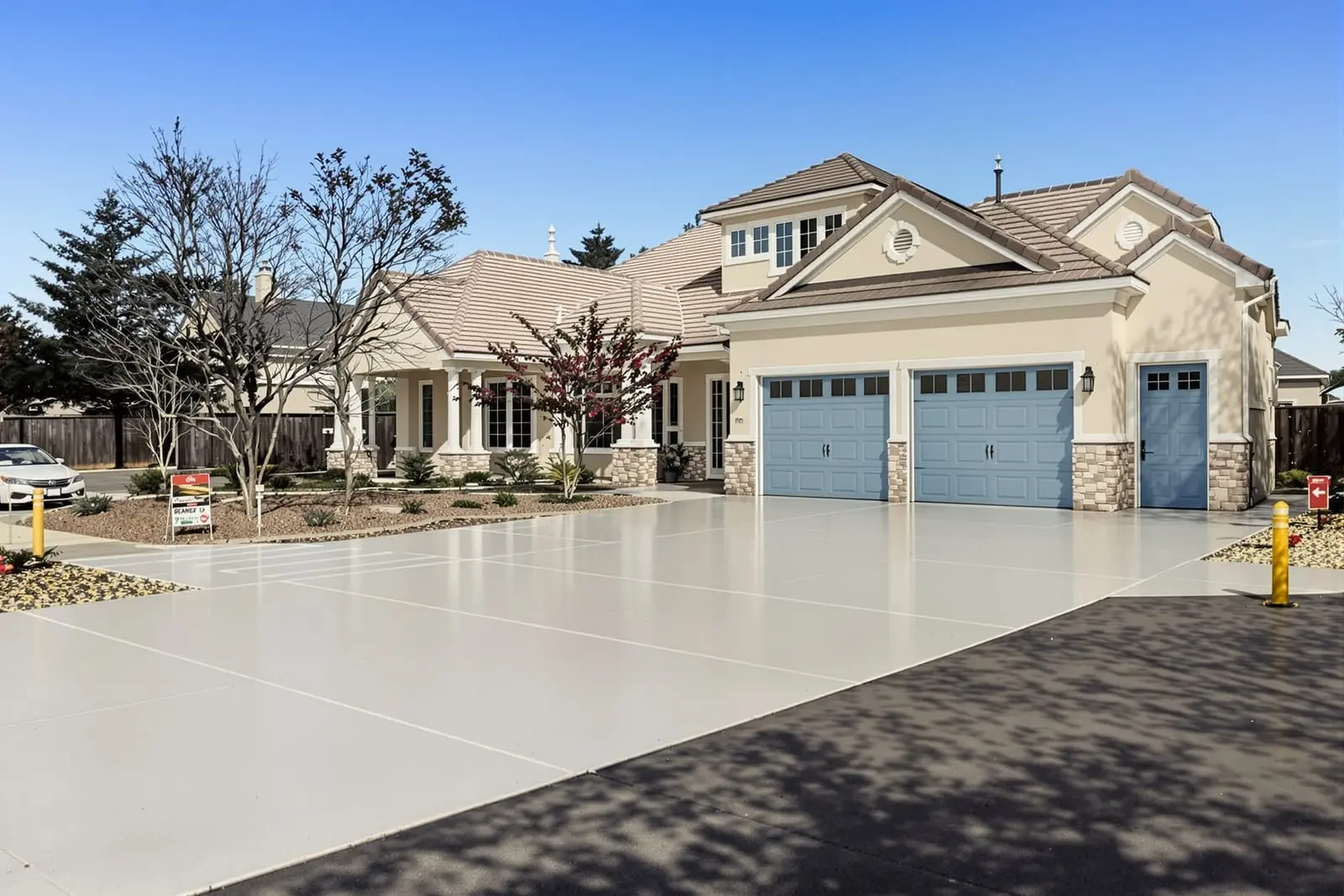
Support your business with reliable commercial concrete paving in Colorado Springs, CO. We install access drives, dumpster pads, loading areas, and site slabs built for heavy traffic. Our team works around business schedules to minimize downtime while delivering durable flatwork that keeps your property safe and professional.
Primetime Concrete Colorado Springs provides professional commercial concrete paving throughout Colorado Springs, CO and the surrounding area. Our licensed, insured crew delivers safe, clean, on-time work with a free estimate before anything begins. Call (719) 826-8457 or request your free quote.
Commercial Concrete Paving for Colorado Springs Businesses
Commercial concrete paving in Colorado Springs has to handle more than just cars in a parking lot. It has to stand up to sudden freeze-thaw cycles, summer heat, snow plows, delivery trucks, and the specific traffic patterns of your business. Primetime Concrete Colorado Springs plans every paving project around those real-world conditions so you get concrete that performs, not just concrete that looks good on day one.
When we talk about commercial concrete paving, we are usually dealing with parking lots, drive lanes, loading zones, dumpster pads, ADA ramps, sidewalks, and fire lanes. Each of these areas carries different loads and sees different wear, so they should not all be poured at the same thickness or with the same reinforcement. For example, a light-use employee parking area at a medical office might be 5 inches thick with fiber reinforcement, while a grocery store loading dock may need 7 to 8 inches with rebar or welded wire mesh.
Colorado Springs has a wide mix of commercial sites: older strip centers built in the 1970s, newer retail pads along Powers and Interquest, industrial buildings on the east side, and office complexes with tight access. Primetime Concrete Colorado Springs is used to working in all of these settings. We plan around existing tenants, tight staging areas, and city requirements so your customers and staff can still function while we work. Our aim is to give you a pavement system that fits how your property is actually used, not a generic one-size-fits-all pour.
How Our Commercial Concrete Paving Process Works
A commercial concrete paving project starts with assessment and layout. We walk the site with you, look at current traffic patterns, drainage issues, heaving or cracking, and any city or ADA compliance concerns. If you have existing asphalt or failed concrete, we determine whether full-depth replacement or partial removal makes the most sense. From there we mark out the work areas, set elevations with lasers, and plan slope so water runs to inlets or swales, not toward entrances or neighboring properties.
Next is demolition and subgrade preparation. Old asphalt or concrete is broken, removed, and hauled off for recycling where possible. We then scarify or rework the subgrade, compact it in lifts, and add road base where the native soil is weak or expansive. In parts of Colorado Springs with clay-heavy soil, such as the northeast and some older industrial sites, extra base and compaction are essential. We use plate compactors and rollers and, if needed, proof-roll with a loaded vehicle to find soft spots before any concrete goes down.
Forming and reinforcement follow. We set forms to the design grade and confirm slopes with levels, typically aiming for a 1 to 2 percent slope to help drainage while still meeting ADA requirements in accessible areas. Depending on your traffic loads, Primetime Concrete Colorado Springs will specify rebar, welded wire mesh, or synthetic fibers, or a combination. Loading docks and dumpster pads nearly always receive heavier reinforcement to prevent rutting and breakup under point loads.
Placing and finishing the concrete comes next. We usually use a 4,000 to 4,500 psi mix for commercial concrete paving in this region, often with air entrainment to handle freeze-thaw cycles and de-icing chemicals. The concrete is placed, screeded to level, bull-floated, and then finished with a broom texture for slip resistance. Edges are tooled for durability, and joints are cut or tooled at calculated intervals to control where the concrete cracks as it naturally shrinks. On larger pours, we saw cut contraction joints as soon as the concrete will allow cutting without raveling.
Curing is the last step many people forget about, but it has a big impact on lifespan. We typically apply a curing compound to slow water loss so the concrete reaches its design strength. In colder weather we adjust timing and may use blankets to protect fresh concrete from freezing. We will also set traffic restrictions, such as keeping passenger vehicles off for at least 3 to 5 days and heavy trucks off for 7 days or more, depending on temperature and mix design.
Local Factors That Affect Cost and Design
The cost of commercial concrete paving in Colorado Springs is driven by more than just square footage. Thickness, reinforcement, access, excavation needs, and weather all matter. A straightforward front parking lot with good access for trucks will typically cost less per square foot than a back alley delivery lane that requires partial hand work, tight maneuvering, and night or weekend pours.
Thickness is one of the biggest cost drivers. A 5 inch parking lot pour uses 25 percent more concrete than a 4 inch slab, and a 7 or 8 inch heavy duty section uses much more than that. Primetime Concrete Colorado Springs looks at your site use, such as regular semi traffic, garbage trucks, snow plow routes, and delivery vans, then recommends thickness by area. This targeted approach keeps you from overpaying where you do not need heavy pavement, while still building up critical points like entrances and loading zones.
Subgrade corrections are another major factor. Parts of Colorado Springs have relatively stable decomposed granite soils, which compact well and keep costs reasonable. Other areas have pockets of expansive clay or poorly compacted fill from older construction. If we discover soft or pumping subgrade during preparation, we may need additional base material, geo-grid stabilization, or deeper excavation. While this adds to upfront cost, it prevents early cracking and settlement that would cost far more to repair later.
Existing conditions and phasing also matter. For occupied retail centers, we often break work into phases so only part of the lot is closed at any time. This increases setup and mobilization costs but allows businesses to stay open with clear access routes. If we are tying new concrete into older structures, such as dock aprons or existing sidewalks, we may need extra saw cutting, detail work, and dowel drilling to manage transitions.
Weather and scheduling in Colorado Springs can influence both timing and price. Late fall and winter pours sometimes require cold-weather measures like heated blankets, accelerator admixtures, or adjusted schedule windows, which affect cost. On the other hand, summer work needs attention to wind and low humidity so the surface does not dry too quickly. We will walk you through the timing options and help balance schedule, business impact, and long-term performance.
Common Problems We Solve in Commercial Concrete Paving
Most commercial concrete paving problems we see in Colorado Springs come from poor base prep, wrong thickness for the load, or neglected drainage. If you already have rutted drive lanes, areas that pond water, or slabs that have heaved or settled, Primetime Concrete Colorado Springs will look for the root cause before recommending a fix.
Poor base prep often shows up as sections that rock under vehicle weight, spider cracking in wheel paths, or sudden dips. In those cases, simply patching the concrete does not last. Our crews will cut out the failed sections, remove weak subgrade, and rebuild with well-compacted base, then tie new concrete into the surrounding slab with dowels so the patch acts as part of the original pavement.
Undersized pavement is another recurring issue. For example, a small commercial building might have been poured years ago with light-duty thickness, then later leased to a company that brings in frequent 18-wheelers. The pavement that was once adequate now cracks and pumps water because it was never designed for those loads. When we replace or upgrade, we may design a heavier section only in the truck paths and loading area, while keeping standard thickness elsewhere.
Drainage problems can be obvious, such as standing water in front of entries, or more subtle, such as water running along joints and weakening the base underneath. We correct these issues by adjusting slopes, adding or resetting inlets, installing trench drains where needed, and ensuring the new concrete has clean run-off paths. In winter, good drainage also reduces ice sheets, which is a major safety and liability concern for business owners.
We also plan for long-term maintenance. Commercial concrete paving will last much longer if joints are sealed periodically, heavy truck paths are inspected for early signs of distress, and de-icers are used correctly. We can advise you on realistic maintenance schedules, how to manage snow plow operations to avoid damaging joints and curbs, and what to watch for so you can budget for future work in phases instead of being surprised by major failures.
What to Expect When You Hire Primetime Concrete Colorado Springs
When you bring in Primetime Concrete Colorado Springs for commercial concrete paving, we start with a site visit and a straightforward conversation about use, budget, and schedule. You will know what areas we recommend for full replacement, where partial depth repair might make sense, and how we plan to maintain access for customers, tenants, and deliveries while work is underway.
Before any work starts, you receive a detailed proposal that spells out thicknesses, reinforcement type, subgrade improvements, and finish. We include notes about phasing, estimated pour days, and expected cure times before re-opening to traffic. That way your property manager, tenants, and staff can plan around the work. We can coordinate with other trades if needed, such as striping companies, landscapers, or utility contractors.
During construction, our crews set up clear barricades and signage so drivers and pedestrians know where to go. We maintain access routes to building entrances and emergency services. For office parks and medical facilities along corridors like Academy, Woodmen, and Garden of the Gods, we often schedule pours outside of peak traffic hours to reduce disruption. You will always have a direct contact person for updates and questions.
After the concrete is placed and cured, we walk the project with you to confirm that slopes, joints, and finishes match the plan. We can help coordinate striping and signage so your lot can reopen efficiently. You will also get guidance on when to schedule the first joint sealing, what to avoid in terms of harsh chemicals, and how to manage heavy equipment so your new pavement reaches its full service life.
Our goal is not just to pour concrete, but to give your Colorado Springs property a pavement system that fits how your business actually operates. With the right design, prep, and follow-through, commercial concrete paving can last for decades and handle the traffic your site sees every day.
“
Professional commercial concrete paving, done right the first time, quality materials, honest pricing, and results that last.
Primetime Concrete Colorado Springs
Commercial Concrete Paving Across Our Service Area