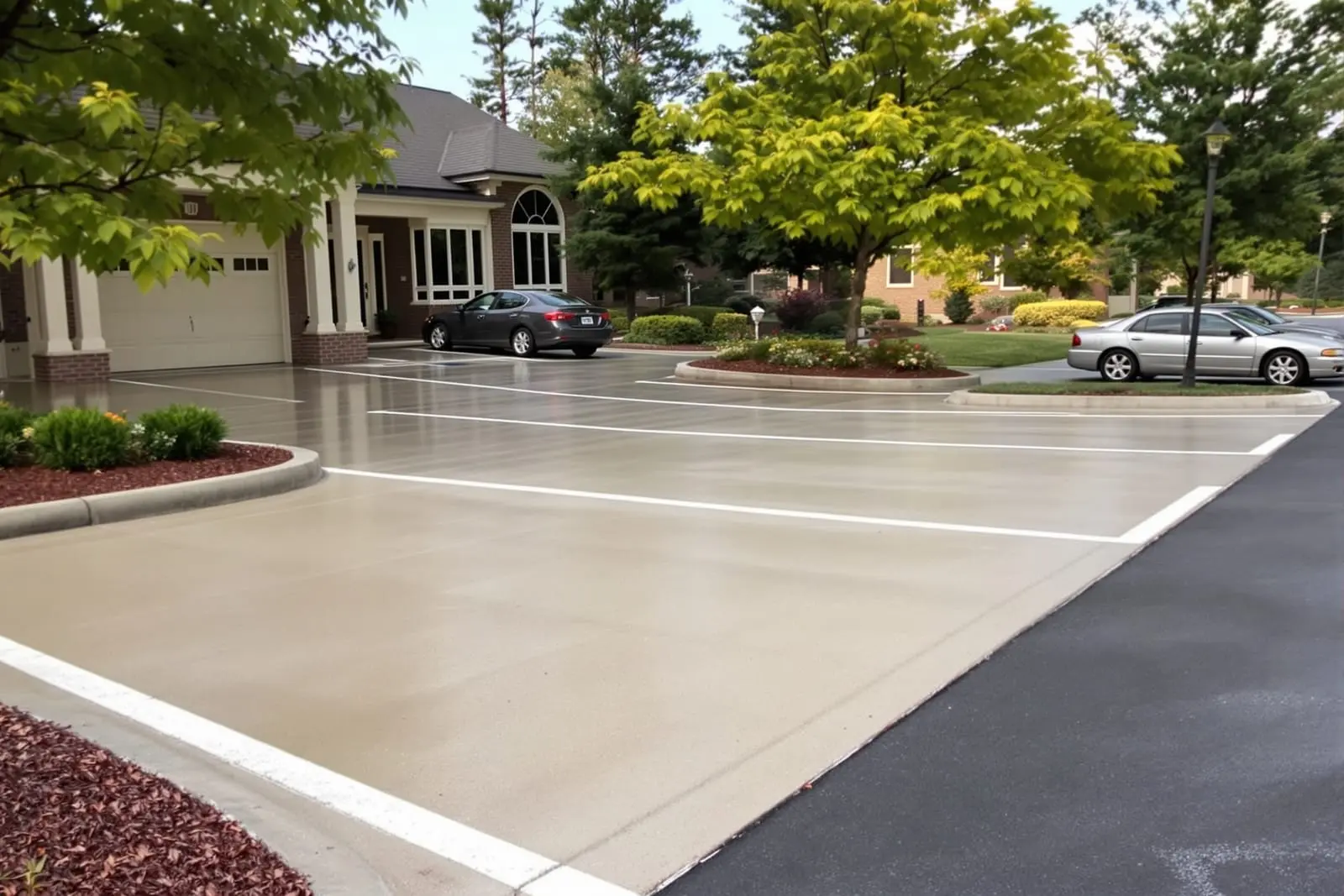
Build a long lasting surface for customers and staff with a concrete parking lot in Colorado Springs, CO. We handle layout, grading, drainage, and paving for small and mid size parking areas. Our concrete sections are reinforced and jointed to resist rutting and potholes from daily vehicle traffic.
Primetime Concrete Colorado Springs provides professional concrete parking lot throughout Colorado Springs, CO and the surrounding area. Our licensed, insured crew delivers safe, clean, on-time work with a free estimate before anything begins. Call (719) 826-8457 or request your free quote.
Durable Concrete Parking Lots Built for Colorado Springs Conditions
A concrete parking lot is more than a driving and parking surface. It is a structural system that has to handle vehicle loads, freeze‑thaw cycles, snow removal equipment, and drainage. Primetime Concrete Colorado Springs designs and builds concrete parking lots specifically for our local climate and soil conditions, so they last longer and need less maintenance.
We start with the use of high strength, air‑entrained concrete mixes that resist de‑icing salts and repeated freezing and thawing common along the Front Range. For commercial clients, we typically design parking lots to at least 4,000 to 5,000 psi compressive strength, with the mix adjusted for placement in cooler or hotter months. Where traffic is heavier, such as near loading zones or drive‑through lanes, we upgrade thickness and reinforcement to handle extra loads.
Our focus is not only on the concrete slab but on the entire system, including subgrade, base material, drainage, and joint layout. Many premature failures in Colorado Springs parking lots are not from the concrete itself, but from poor preparation below the slab and inadequate attention to water control. We address those issues up front so your investment performs for decades, not just a few years.
How We Install a Concrete Parking Lot Step by Step
Primetime Concrete Colorado Springs follows a repeatable, engineered process for every concrete parking lot, whether it is for a small medical office or a multi‑acre commercial center.
1) Site evaluation and layout. We begin with a walkthrough to review traffic flow, required slopes for drainage, snow storage areas, and any existing pavement or structures. We verify property lines and any utility conflicts, then establish elevation benchmarks and layout with stringlines or laser equipment.
2) Demolition and excavation. If there is existing asphalt or concrete, we sawcut and remove it, then excavate to the design depth. For new construction, we excavate to allow for the base rock plus the concrete slab thickness, usually between 5 and 7 inches for light to medium duty parking lots in this area.
3) Subgrade preparation and base. We compact the native soil with plate compactors or rollers and proof‑roll to identify soft spots. Any yielding areas are undercut and replaced with road base. We then install and compact a layer of Class 6 road base or similar crushed aggregate, typically 4 to 8 inches thick depending on soil conditions and load requirements. Proper compaction here is critical to avoid settlement and cracking later.
4) Forms, reinforcement, and thickened edges. We set forms to the exact elevations needed to achieve the planned slopes for drainage. For reinforcement, we commonly use rebar grids or welded wire fabric tied and supported on chairs so it stays in the middle of the slab, not at the bottom. In drive lanes, dumpster pads, or near loading docks we may design thickened edge beams or additional reinforcing to resist truck traffic.
5) Concrete placement and finishing. We pour the concrete using chutes or pump trucks, strike it off to grade, then use bull floats and power trowels or brooms to achieve the specified finish. For parking lots, a broom finish is standard to provide traction during snow and ice. We pay special attention to edges, around inlets, and at transitions to sidewalks or building entries to avoid trip hazards.
6) Jointing and curing. We sawcut control joints as soon as the concrete can support the saw without raveling, normally within 6 to 18 hours depending on weather. Joint spacing is calculated based on slab thickness to help control where cracks form. We apply curing compounds or use wet curing methods to slow moisture loss, which improves strength and durability.
7) Striping and re‑opening. After adequate curing, usually 7 days for light traffic and up to 28 days for heavy trucks, we coordinate or provide striping, accessible parking markings, and signage so the lot is ready for safe use.
Design Options and Traffic Ratings for Your Concrete Parking Lot
Not every concrete parking lot in Colorado Springs should be built the same. Primetime Concrete Colorado Springs designs each project around how the lot will actually be used, and we walk you through the options so you are not overbuilding or underbuilding.
For light duty parking lots that serve cars and light pickups only, such as small offices or churches, we often specify 5 inch slabs with standard reinforcement and well compacted base. Medium duty lots that see more frequent delivery trucks may move to 6 inch slabs and upgraded reinforcement. Heavy duty or industrial sections, like trash enclosure pads, drive‑through lanes, or fire lanes, may go to 7 inches or more with additional steel or doweled joints.
We also consider surface finish and appearance. Broom finished gray concrete is the norm, but for higher visibility front entries or dealership display rows we can provide troweled bands, colored concrete, or decorative sawcut patterns without compromising structural performance. Where reflectivity is important for nighttime lighting, we can choose mix designs and finishing methods that keep the surface bright.
Drainage design is critical in our region because of sudden thunderstorms and snowmelt. We build in slopes of at least 1 to 2 percent toward inlets or perimeter swales, avoiding flat areas that can collect ice. Where existing buildings constrain elevations, we fine tune grades so water moves away from the structure without creating steep or uncomfortable walking areas.
For businesses with specific needs, such as hospitals, schools, or multi‑tenant retail centers, we coordinate parking layouts around ADA compliance, fire department access routes, and expected peak traffic. The goal is a concrete parking lot that operates smoothly and safely as well as holding up structurally.
What Affects the Cost of a Concrete Parking Lot in Colorado Springs
Many property owners want to know why one concrete parking lot bid is higher than another. Primetime Concrete Colorado Springs is transparent about cost drivers so you can compare proposals on an apples‑to‑apples basis.
Lot size and shape are the obvious factors. Simple rectangular layouts waste less material and labor than lots with many islands or curves. Thickness is another major driver. Increasing slab thickness even by 1 inch across a large area adds significant cubic yards of concrete.
Soil conditions and base requirements can change pricing substantially in Colorado Springs. Lots built over well drained, stable soils are more economical than those over clay pockets or poorly compacted fill. If test pits or experience at your site indicate soft subgrade, we will include undercutting and additional base rock, which adds cost but prevents expensive failures later.
Access and phasing influence labor efficiency. A wide open new construction site allows large equipment and easy truck access, which reduces labor hours. Tight urban or existing sites where we must phase work to keep portions of the parking lot open can take longer and cost more. Night or weekend work, sometimes required for busy retail centers, may also affect the price.
Additional features such as thickened dumpster pads, reinforced loading areas, curb and gutter, integral sidewalks, and decorative concrete will also impact the overall budget. We break these items out so you can see exactly where your investment is going and decide which options offer the best return for your property.
Common Concrete Parking Lot Problems and How We Prevent Them
Colorado Springs sees wide temperature swings, freeze‑thaw cycles, and the use of de‑icing chemicals, all of which can be tough on concrete. Primetime Concrete Colorado Springs designs concrete parking lots to reduce the most common issues we see in older or poorly built lots.
Premature cracking often comes from inadequate subgrade support or poorly spaced control joints. We address this by carefully compacting the base, using the proper slab thickness, and placing control joints at calculated intervals. While some hairline cracking is inevitable in any large slab, proper jointing ensures it happens where it is least visible and least harmful.
Spalling and surface scaling can occur when non air‑entrained concrete is exposed to freeze‑thaw cycles and de‑icing salts, or when finishing is done with excess bleed water. We use air‑entrained mixes appropriate for exterior slabs and avoid steel trowel finishes on regular parking surfaces, which can trap water at the top. Our crews are trained to finish concrete at the right time, not while bleed water is sitting on the surface.
Poor drainage leads to standing water, ice buildup, and long‑term damage. We prevent these issues by designing and building consistent slopes, double checking grades before each pour, and tying slab elevations into existing structures and inlets. Where existing drainage is limited, we can suggest added drains, trench drains near overhead doors, or re‑grading adjacent areas to move water away.
In renovation projects, we frequently see edge failures where thin asphalt meets thicker concrete, such as at building entries or patch repairs. When we replace or expand parking lots, we tie new and existing concrete together with dowels where appropriate and design stronger edge conditions where heavy vehicles turn or stop.
Timing Your Parking Lot Project Around Colorado Springs Weather
Concrete parking lot work in Colorado Springs can be done most of the year, but planning around weather can save money and reduce schedule risk. Primetime Concrete Colorado Springs completes installs from spring through late fall, and we also manage winter projects when needed by adjusting our methods.
The ideal window for a new concrete parking lot is typically April through October, when daytime temperatures support proper curing and overnight lows stay above freezing most of the time. During this period, we can pour larger sections at once and sawcut joints on a predictable schedule.
In late fall and winter, we take extra precautions such as using cold weather concrete mixes with accelerators, insulating blankets, and sometimes temporary heat to keep the concrete within the correct temperature range while it gains strength. These steps allow off‑season work, but they also add cost, so if you have schedule flexibility, we recommend planning major pours for milder months.
Storms along the Front Range can develop quickly, particularly in summer afternoons. We schedule pours early in the day when possible and monitor forecasts closely. If necessary, we adjust start times or reschedule to avoid pouring just before heavy rain or hail. Proper planning prevents surface damage and allows us to maintain quality without costly rework.
For active businesses, timing also means phasing. We can divide the parking lot into sections, keeping customer access open while each phase is completed and cured. This may extend total project duration but minimizes interruptions to your operations.
New Installs, Replacements, and Repairs for Existing Parking Lots
Primetime Concrete Colorado Springs works on all types of concrete parking lot projects, from the first install on a new commercial building to replacement of worn asphalt and targeted repairs on existing properties.
For full replacements, especially when converting an old asphalt lot to concrete, we evaluate whether the existing base can be reused. In some cases, the underlying aggregate can be re‑graded and compacted to serve as a base for the new concrete, which saves on trucking and material costs. In other cases, especially where there has been long‑term water infiltration, we recommend removing and replacing the base to ensure a stable foundation.
When a lot is mostly sound but has specific failures, we can perform sectional removals and replacements. This involves sawcutting around the damaged area, removing the slab, repairing or improving the base, then pouring new concrete that is doweled into the surrounding slab. This method is well suited for localized issues at dumpster pads, repeated rutting in drive‑through lanes, or failed sections around catch basins.
We also address joint and crack maintenance on older concrete parking lots. Sealing or re‑sealing joints and significant cracks helps keep water out of the subgrade, reducing freeze‑thaw damage and pumping. Where joints have spalled, we can route and repair them with suitable materials so they are safer and extend the service life of the lot.
Before we recommend a solution, we inspect the lot, discuss your budget and timeline, and prioritize work by urgency. Sometimes it makes sense to phase replacements over several years, addressing the most critical structural or safety issues first while planning for longer term upgrades.
“
Professional parking lot concrete, done right the first time, quality materials, honest pricing, and results that last.