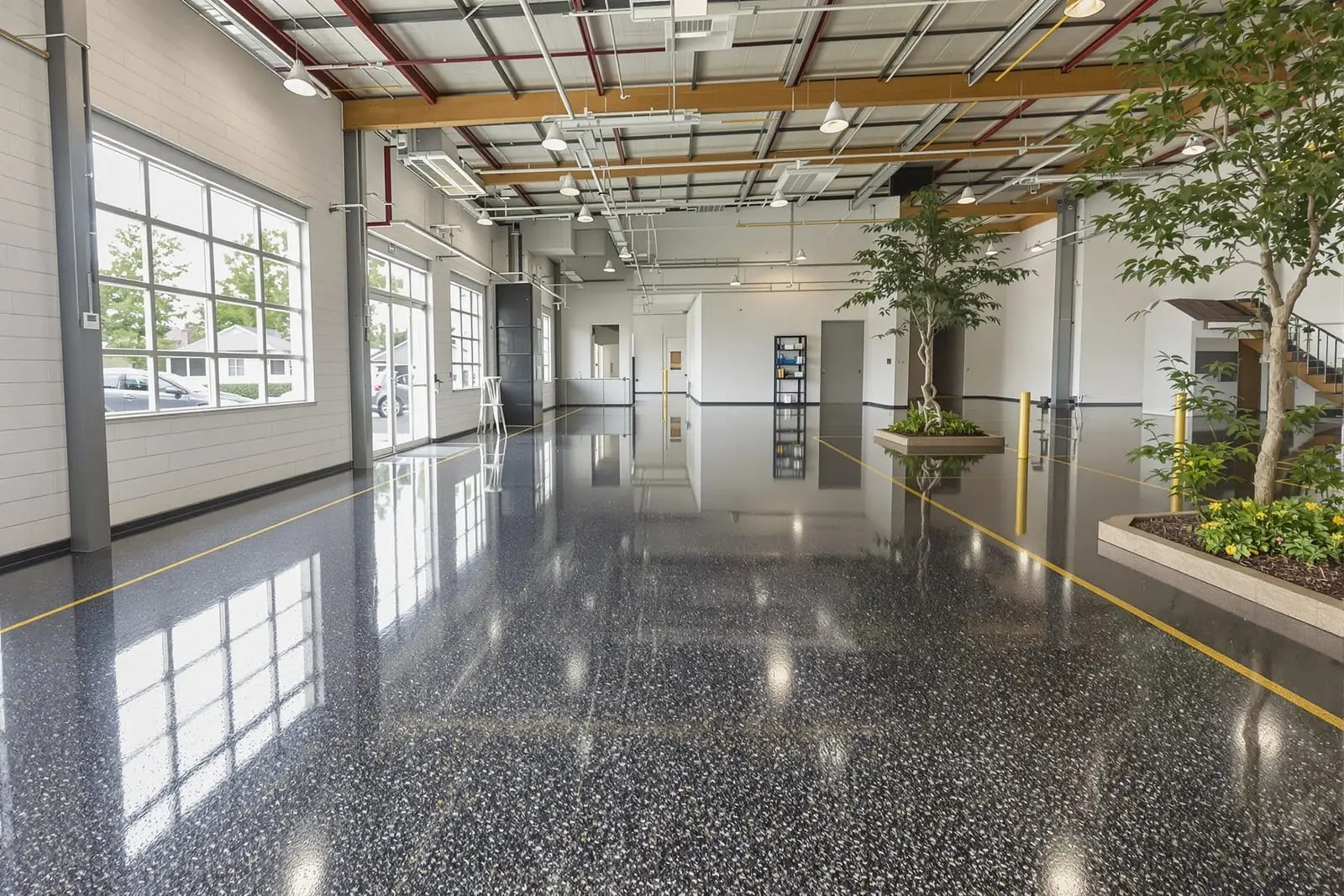
Equip your facility with durable industrial concrete floors in Colorado Springs, CO. We pour and finish slabs engineered for forklifts, racks, and heavy equipment loads. Flatness, joint layout, and reinforcement are carefully planned so your warehouse floor performs reliably and minimizes maintenance.
Primetime Concrete Colorado Springs provides professional industrial concrete floors throughout Colorado Springs, CO and the surrounding area. Our licensed, insured crew delivers safe, clean, on-time work with a free estimate before anything begins. Call (719) 826-8457 or request your free quote.
Durable industrial concrete floors for Colorado Springs facilities
Warehouses and industrial buildings along I-25, the airport corridor, and in older Colorado Springs industrial parks need concrete floors that can handle forklifts, pallet jacks, racking loads, and temperature swings without constant repair. Primetime Concrete Colorado Springs focuses specifically on industrial concrete floors, so we design each slab to match how your operation actually runs, not just to a generic spec.
When we look at your warehouse or plant, we start with use: what kind of equipment you run, wheel types, racking layout, and whether you have point loads from storage racks or machinery. A forklift with hard polyurethane tires, for example, demands a smoother surface and tighter joints than a facility that mainly uses pallet jacks. We also look at whether you need moisture control for packaging, electronics, or food storage and how your heating and ventilation affect slab temperatures. All of this influences slab thickness, reinforcement type, and finishing method.
Our projects range from new tilt-up warehouses on the north side of town to retrofits of older concrete buildings near downtown and small industrial bays in business parks. Each one gets a custom mix design, joint layout, and curing plan tailored to our high-altitude, semi-arid climate and freeze-thaw cycles.
How we design industrial concrete floors for your operation
Design is where an industrial concrete floor is either set up for decades of performance or years of patching. At Primetime Concrete Colorado Springs, we start by working from your structural drawings if you already have an engineer on the project. If not, we coordinate with a local structural engineer to confirm slab thickness, base requirements, and reinforcement. Typical warehouse slabs in the Colorado Springs area run from 5 to 8 inches thick, but thickness alone does not guarantee performance.
We look closely at subgrade conditions. Many local industrial sites have fill soils, especially near former rail and railyard areas, or have expansive clays on the east side of town. For these, we coordinate compaction testing and often recommend a well-compacted road base layer beneath the slab to prevent differential settlement and cracking. In some cases, we will suggest a vapor barrier under the slab, particularly for facilities that store paper goods, food products, or electronics where ground moisture can cause damage.
Reinforcement choice is another key decision. For simple storage areas with moderate traffic, a well-designed slab-on-grade with rebar or welded wire mesh may be sufficient. For higher load areas like forklift aisles or machine foundations, we will often recommend a combination of rebar in specific zones and micro or macro synthetic fibers in the mix to control shrinkage cracking and improve toughness. Joint spacing, layout, and joint type (saw cut, keyed, or doweled) are tailored to forklift traffic patterns, dock door locations, and racking rows to reduce long-term joint damage.
Our installation process for warehouse and industrial slabs
Once the design is set, the success of your industrial concrete floor depends on careful execution. We begin by preparing the subgrade, which includes proof-rolling to find soft spots, compacting to the proper density, and building up a uniform base course. In Colorado Springs, where freeze-thaw and occasional subsurface moisture can create movement, we put extra attention into consistent base thickness and proper drainage away from the building.
We then form the slab area, install any edge forms, and place reinforcement according to the structural plan. Rebar chairs, supports for welded wire mesh, and dowel baskets at planned construction joints all ensure the steel is in the correct position during placement. At this stage we also set anchor bolts, sleeves, and blockouts for future machinery or trenches if needed, which avoids costly saw cutting later.
Concrete placement is coordinated so we pour large, continuous panels whenever possible. We use commercial-grade ready-mix designed for industrial applications, typically with a higher compressive strength and lower water-cement ratio for durability. Our crews use laser-guided screeds or carefully set guide rails to achieve very flat surfaces where required, such as in high-bay racked storage or for autonomous material handling systems.
Finishing is timed to local conditions. In Colorado Springs, the dry air and sun can accelerate surface drying, so we manage placement time, wind exposure, and evaporation control to prevent surface checking. We typically use mechanical power trowels to achieve a hard, smooth finish for most warehouse operations, or a lightly textured finish in areas where slip resistance is a priority.
Surface treatments, hardeners, and finish options
Industrial concrete floors do not all have to look the same, and the right finish can significantly reduce maintenance. Primetime Concrete Colorado Springs offers a range of surface treatments specifically chosen for warehouse and industrial use in our climate.
For heavy forklift traffic, we often apply a liquid chemical hardener that reacts with the concrete surface to increase abrasion resistance and reduce dusting. When combined with a multi-step mechanical polishing process, this can give you a dense, easy-to-clean surface that does not peel like some coatings. Polished industrial floors are popular in facilities that want brighter interiors because the reflective surface can improve lighting efficiency.
In loading areas, battery charging zones, or spaces where oils and chemicals are used, we may recommend high-performance epoxy or polyurethane coatings instead. These systems provide a more chemical-resistant barrier, but they require careful surface preparation, including grinding or shot blasting and testing for moisture vapor emissions. Due to altitude and temperature swings in Colorado Springs, we plan coating schedules to avoid extreme cold or heat and follow manufacturers' cure times closely.
For older warehouse floors that are being repurposed, such as turning an older distribution space into light manufacturing, we can grind, repair joints, fill cracks, and overlay or coat the existing slab. This approach can often save money compared to full slab replacement while giving you a surface tailored to your new use.
What affects cost and timeline for industrial concrete floors
Budgeting for an industrial concrete floor is easier when you understand what actually drives cost. At Primetime Concrete Colorado Springs, we break it down for you before work begins, so there are no surprises.
The biggest factors are slab thickness, reinforcement type, and subgrade preparation. A 6-inch slab with standard reinforcement on a firm site will be very different in cost from an 8-inch slab with heavy rebar on a site that needs extensive soil correction. Access for concrete trucks and finishing equipment also affects labor. Tight sites in older industrial districts or interior tenant improvements inside existing buildings often require more labor-intensive methods.
Surface specification is another major driver. Floors that need high flatness and levelness tolerances for high-bay racking require more precise screeding, more experienced finishers, and careful joint layout. Polished finishes or multi-layer coating systems add cost but can pay off in reduced long-term maintenance and cleaning time.
Timeline depends on slab size, complexity, and cure requirements. Even if a floor feels hard after a few days, the concrete continues to gain strength for weeks. For heavy rack installation or setting large equipment, we typically coordinate with your structural engineer to confirm when design strength is reached. We also account for local weather patterns. For example, winter work in Colorado Springs may require heated enclosures or temporary heat to maintain slab temperature, while summer work may require early morning placements to avoid rapid surface drying.
Common problems and how we prevent them
Many calls we receive are from facility managers frustrated with existing floors that were not designed or installed for real industrial use. Common issues include wide uncontrolled cracks, spalling at joints where forklift wheels hit, dusting surfaces that are hard to keep clean, and slabs that curl at edges and cause trip hazards. Primetime Concrete Colorado Springs focuses on preventing these problems from the beginning, using practices that are specific to industrial work in our region.
Cracking cannot be eliminated in concrete, but it can be controlled. We carefully plan joint spacing, location, and depth based on slab thickness, reinforcement, and local temperature swings. Saw cutting is scheduled as soon as the concrete is strong enough, which in our drier climate must be balanced against the risk of raveling. We also specify proper curing methods, such as curing compounds or wet curing where feasible, to minimize shrinkage and improve surface durability.
To protect joints from heavy industrial traffic, we often use doweled joints and install semi-rigid joint fillers after the slab has undergone initial shrinkage. This supports forklift wheels and prevents the edges from breaking off. In areas where existing joints are already damaged, we can saw-cut, clean out, and rebuild joint edges, then install proper fillers to restore performance.
Dusting floors are usually the result of weak surface paste or inadequate curing. For new floors, we use mix designs and curing practices that produce dense surfaces. For older dusty floors, we can perform mechanical surface prep, apply hardeners or densifiers, and in some cases grind and polish to create a more durable and dust-free finish.
When you contact Primetime Concrete Colorado Springs about warehouse or industrial concrete floors, we walk your facility with you, identify current or potential problem areas, and explain specific options so you can choose the right long-term solution for your operation.
“
Professional warehouse & industrial concrete floors, done right the first time, quality materials, honest pricing, and results that last.
Primetime Concrete Colorado Springs
Warehouse & Industrial Concrete Floors Across Our Service Area