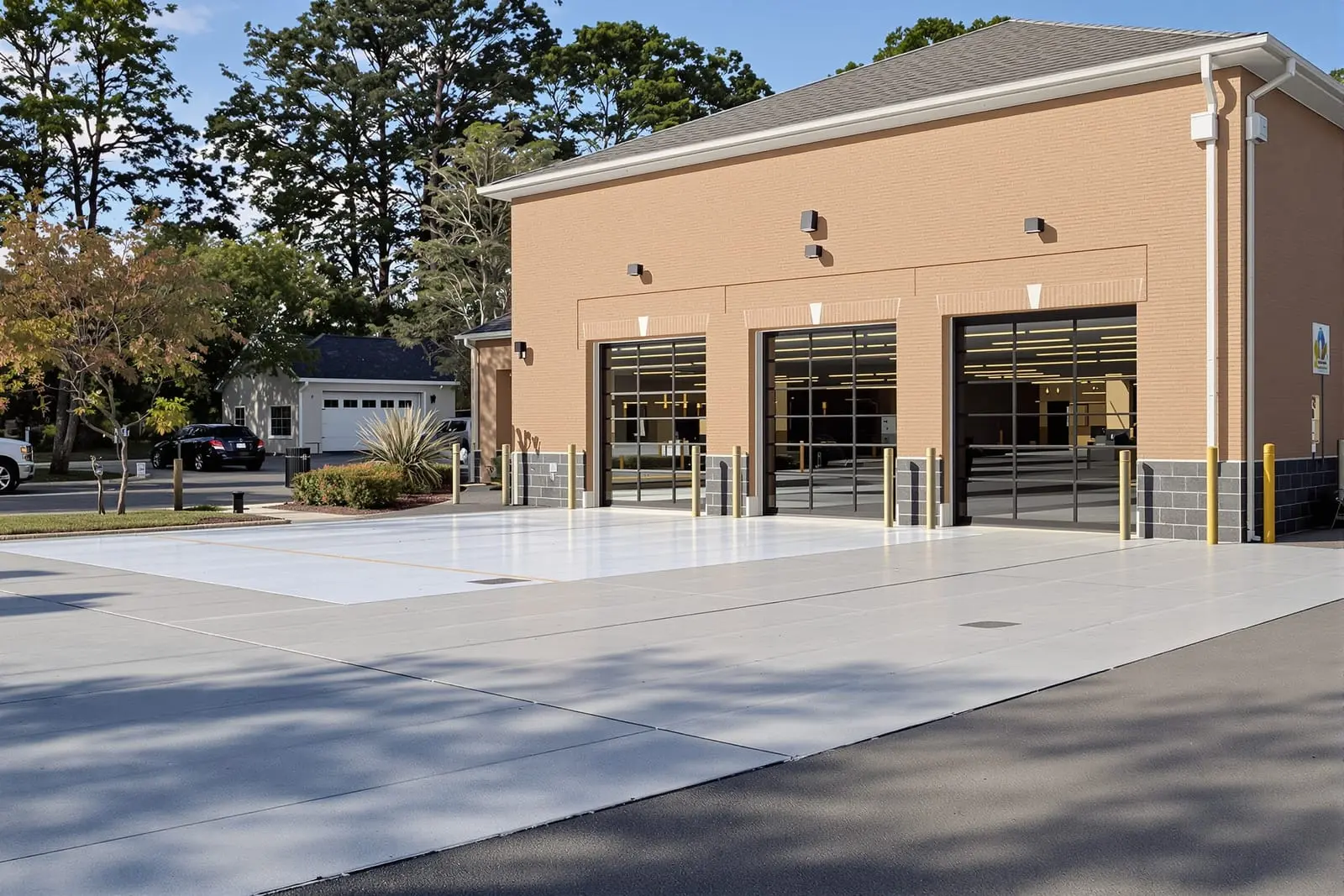
Handle heavy loads with properly built commercial concrete slab work in Colorado Springs, CO. We pour loading docks, dumpster pads, and equipment slabs designed for repeated impact and point loads. Thickness, reinforcement, and joint layout are engineered to keep your operations running smoothly.
Primetime Concrete Colorado Springs provides professional commercial concrete slab throughout Colorado Springs, CO and the surrounding area. Our licensed, insured crew delivers safe, clean, on-time work with a free estimate before anything begins. Call (719) 826-8457 or request your free quote.
Engineered Loading Docks and Commercial Slabs in Colorado Springs
Primetime Concrete Colorado Springs designs and installs commercial concrete slab systems that match how your facility actually operates. For loading docks, warehouse floors, retail back-of-house areas, and equipment pads, we focus on load capacity, traffic patterns, and long-term durability in our local climate.
Colorado Springs introduces unique challenges for commercial concrete slab work: rapid freeze-thaw cycles, slope on many sites along the Front Range, and variable soils from expansive clays on the east side to more granular soils toward the foothills. We account for those conditions from the first site visit so your dock or slab does not settle, heave, or ravel at the joints.
Whether you need a recessed truck dock behind a distribution center, a drive-in loading area for a small manufacturer, or a heavy-duty commercial concrete slab to support racking, forklifts, and pallet jacks, we match the slab design to your real loading needs, not just a generic detail from a plan book.
How We Design Commercial Concrete Slabs for Your Operation
Every commercial concrete slab starts with data. Primetime Concrete Colorado Springs reviews your intended use, including forklift types and weights, pallet loads, rack leg loads, and whether you plan to add machinery later. We then look at subgrade conditions, drainage paths, and existing structures on site.
From there we determine thickness and reinforcement. Typical light commercial floors in Colorado Springs are 5 to 6 inches thick with fiber reinforcement or #4 rebar at 18 inches on center. For heavy rack storage, reach trucks, or dock impact loads, we may recommend 6 to 8 inches with closer bar spacing or welded wire reinforcement. In high-impact dock areas, we often add doweled joints at thresholds and between slab panels to handle wheel loads at slab edges.
We also evaluate vapor conditions. If your slab will receive epoxy, polished concrete, or resilient flooring, we may specify a vapor barrier and lower water-cement ratio concrete to resist moisture transmission. For coolers, freezers, or food production, we can coordinate insulation and slope to trench drains so your slab performs with the rest of the building systems.
Loading Dock Construction Details That Prevent Damage
A loading dock fails first at its edges and transitions, not in the middle of the slab. Primetime Concrete Colorado Springs focuses on these high-stress points so your docks stand up to repeated trailer impacts and daily forklift traffic.
Dock approaches are typically sloped 6 to 8 percent so trailers can meet dock levelers properly. We form and pour that approach slab with accurate grade control so water drains away from the building and does not pond at the dock doors, which is especially important when snowmelt refreezes overnight in Colorado Springs winters.
At the dock face, we install embedded steel angles, curb walls, or heavy-duty dock bumpers with anchor bolts set into the concrete. The concrete behind these elements is thickened and reinforced so impact loads transfer into the slab instead of spalling the face. Where dock levelers or edge-of-dock levelers will be installed, we coordinate with the equipment supplier to form and pour pockets, pour-stops, and anchor points so the installer can set the equipment without cutting or patching the slab later.
Transition areas between the interior commercial concrete slab and the exterior dock apron are doweled and sometimes armored with steel to prevent curling and chipping at the joint. For facilities expecting heavy yard trucks or container chassis, we can design thicker apron sections or concrete paving that transition smoothly into your asphalt yard.
Concrete Mixes and Reinforcement Built for Front Range Conditions
Not every commercial concrete mix performs well at 6,000 feet. Primetime Concrete Colorado Springs works with local ready-mix suppliers to specify mixes created for Colorado Springs freeze-thaw cycles and deicing chemical exposure.
For exterior loading dock aprons, we typically use a 4,500 to 5,000 psi air-entrained mix with low water-cement ratio. Air entrainment helps resist surface scaling from freeze-thaw cycles and magnesium chloride used on roads and parking lots. Inside warehouses and production areas, we may use non-air-entrained mixes with admixtures that improve finishability and reduce shrinkage, especially if you plan to polish the slab.
Reinforcement options include deformed rebar, welded wire reinforcement, and structural fibers. For many commercial concrete slab projects we use a hybrid approach, for example, microfibers to control plastic shrinkage cracking plus rebar at construction joints and dock edges where we expect concentrated loads. In high-corrosion environments, such as chemical handling or snowmelt-intensive sites, we can specify epoxy-coated bars or synthetic fibers to extend slab life.
We also pay attention to curing. In the dry Colorado Springs climate, evaporation rates can be extremely high, which leads to surface cracking and reduced strength if the slab is not cured properly. We use curing compounds or wet curing methods and coordinate with your schedule so forklifts and racks are not placed on the slab before it reaches adequate strength.
Subgrade Preparation, Drainage, and Frost Considerations
The performance of any commercial concrete slab is determined largely by what is under it. Primetime Concrete Colorado Springs starts by evaluating existing soils, previous fill, and drainage patterns. On many local sites, we encounter fill from past construction or imported material that was not compacted correctly. Leaving that in place often leads to slab settlement and cracking.
We typically over-excavate soft or undocumented soils and replace them with compacted structural fill or road base compacted to at least 95 percent of modified Proctor density. In dock areas where trucks brake and turn, we often increase base thickness to minimize rutting and pumping at joints.
Drainage is equally important. Dock aprons should slope away from the building and toward catch basins, trench drains, or parking lot inlets. In Colorado Springs, where sudden summer storms are common, undersized or poorly sloped aprons can send water straight into dock doors or warehouse entries. We set forms and check grades with laser equipment so water flows where it should.
Frost heave is a concern in some parts of El Paso County where soils hold water. To reduce heave, we improve drainage, separate slabs from frost-susceptible soils with free-draining base, and design isolation joints at columns and walls so minor ground movement does not crack the slab or push against your structure.
Permits, Inspections, and Local Code Coordination
Commercial concrete slab and loading dock work in Colorado Springs usually requires coordination with the Pikes Peak Regional Building Department or the local authority having jurisdiction if you are outside city limits. Primetime Concrete Colorado Springs can work from engineer-stamped plans you provide, or we can coordinate with local engineers to deliver a stamped slab and dock design that meets code and your insurer’s requirements.
Depending on project size and whether you are modifying an existing building or constructing a new facility, you may need permits for structural work, grading, and drainage. We help identify which inspections will apply, such as footing and foundation, pre-pour slab inspection, and sometimes reinforcement or embed inspections for dock levelers and guard rails.
We also coordinate with other trades. For example, if there are under-slab utilities, floor drains, or conduit for dock equipment, we schedule layout and trenching before base preparation and reinforcement placement. This avoids last-minute cutting of your finished slab and helps you pass inspections the first time.
For operations governed by specific standards, such as food processing, cannabis facilities, or fire code storage requirements, we work with your design team to ensure slab slopes, joint sealants, and surface finishes align with your compliance needs.
Budget, Schedule, and What Affects Cost
Primetime Concrete Colorado Springs builds realistic budgets around how you plan to use your loading docks and commercial slabs, not just square footage. Major cost drivers include slab thickness, reinforcement type and quantity, base preparation, drainage structures, and any specialty finishes or coatings you require.
For example, a basic 6 inch commercial concrete slab on well-compacted existing base will cost less than a heavy-duty 8 inch dock apron with thickened edges, doweled joints, and armored dock faces. If your site requires substantial over-excavation or import of structural fill, that will affect both price and schedule. Similarly, a slab that must be laser screeded to tight flatness tolerances for very tall racking systems may require different equipment and more finishing labor.
Weather and phasing also matter. In winter, cold temperatures and possible snow events in Colorado Springs can require heated enclosures, ground thawing, or accelerators in the mix, which affect cost. If your facility must stay operational, we can phase the work, for example, keeping part of your dock line active while we demo and rebuild other positions, but this often adds mobilizations and traffic control to the budget.
We provide detailed proposals that break out major components so you see where your investment is going: demolition and haul-off (if any), excavation and base, formwork, reinforcement, concrete placement and finishing, curing, joint cutting and sealing, and any coordination with dock equipment suppliers. Our goal is a commercial concrete slab and loading dock system that supports your business for decades with minimal unplanned maintenance.
“
Professional loading docks & commercial slabs, done right the first time, quality materials, honest pricing, and results that last.
Primetime Concrete Colorado Springs
Loading Docks & Commercial Slabs Across Our Service Area